Story originally published in
The Steamboat Pilot, July 7, 1983
James Harvey Crawford:
1845 - 1930
A dreamer of great dreams
James Harvey Crawford, with his wife Margaret, built a small cabin near the Yampa River in 1876. It was the first "permanent" structure in what became Steamboat Springs. The family established the first school, the first church, the first library and first newspaper for the community. On July 4 they raised the first American flag in the area.
This month they are honored as recipients of the Stanley Larson Pioneer Award, given to residents of Routt County who, in times past, had vision, integrity and concern for their fellow men.
by LULITA CRAWFORD PRITCHETT
Only a handful of old timers can remember James Harvey Crawford. It has been 109 years since he sat on the little hill above the spring that chugged like a steamboat and, on that June day 1874, envisioned a town in what was then sagebrush and willows. I hope you will indulge me, his granddaughter, in a few family memories.
From some of the older kinfolks, we children liked to hear what had happened away back yonder. When James was a little lad, his mother, Sarilda Jane, thought surely he would grow up to be a preacher. The farm on which he had been born in 1845 was near Bethlehem Church, six miles south of Sedalia, Missouri. Ground for the church and burial plot had been given by John Edward, his father, who also lined the hymns for the congregation. Young James "preached" to his sisters, Cynthia and Anne, and then shook hands with the weeds. The stream called Spring Fork, which served the congregation as a baptismal fount, was a convenient place for James to baptize the baby turkeys. Unfortunately, those turkeys all died.
During the Civil War Missouri was torn with strife. On February 10, 1862, six weeks before James would have been 17, he enlisted in the Union Army without telling his folks. He put on his new uniform, rolled up his homespun clothes, tied them behind his saddle, and raced his horse home. His pa said, "I might have known it!"
The officer who swore him in and had been acquainted with him all his life did not even ask his age. He wrote down 18. With Company E, 7th Missouri Cavalry, James fought in seven major battles and any number of skirmishes, and on April 14, 1865 was mustered out as first lieutenant. That was the day Abraham Lincoln was assassinated.
A little more than a month later, on May 25, James was married to his childhood sweetheart, Margaret Emerine Bourn. She was 16 and he was 20. For eight years they farmed. But James was restless. In 1872 he, with several other young Missourians, rode the Kansas Pacific train to Denver City and visited the mining camps and the colony at Greeley. He yearned to see beyond the big mountains, convinced that somewhere to the west was the place he wanted to live.
What followed is now a page in history. He sold his farm and in 1873 brought his wife and three children across the plains in wagons to Colorado Territory, where his fourth child was born some years later.
By 1874 he had, with great difficulty, crossed the Continental Divide to Hot Sulphur Springs. Still not satisfied, he explored farther, staked a claim at the mineral springs near the big bend of Bear River, eventually laid out a townsite, and became the founder of the town of Steamboat Springs.
He dedicated his life to making it a good place to live. Specifically, he hoped to build a health resort that would attract people from all over the world. Like Colorado Springs and Greeley, Steamboat Springs began as a temperance town. It remained so until 1939. He was the town's first postmaster, first mayor, county judge, and school superintendent. The Crawford cabin was the scene of the first Sunday school and the first church service in Yampa Valley.
The voters of Grand and Routt counties sent James to the Second General Assembly of the State Legislature, which convened in Denver on January 1, 1879. Again, they sent him to the Sixth General Assembly, which convened January 5, 1887. Here he introduced a bill, that was passed, to protect the beaver. This animal had been trapped almost to extinction. Long before most people had ever heard of ecology, he foresaw the need to conserve natural resources and maintain the balance of nature.
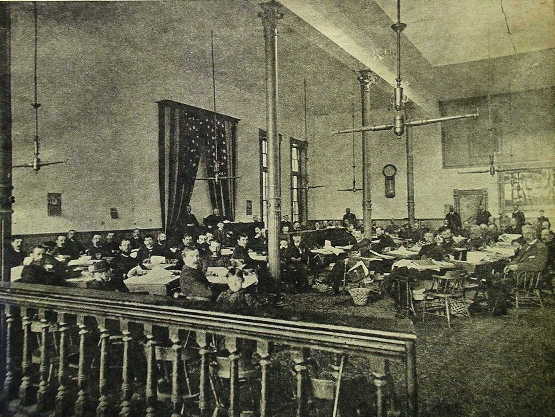
The Sixth General Assembly, Colorado State Legislature, met during the years 1887-1889. The building was located at 1845-1851 Larimer Street, in the Windsor Hotel block. Crawford, representative from Routt and Grand counties, is seen in the back row, at the far left edge of the photograph.
Meanwhile, he had formed a town company with four Boulder men. To fit the dreams of its founder, Steamboat Springs was platted on a large scale, lots being 50 feet to the front, 140 feet deep. Streets were 80 feet wide except Lincoln Avenue, which was 100 feet wide. For awhile lots sold well and the town thrived. But expenditures were heavy. The original company lacked sufficient financial strength, and time and again tried to sell to a stronger company. Time and again, individuals and groups "bought" Steamboat Springs, and fizzled out.
The years slowed to a heavy tread. The health resort never materialized. The railroad was more than a quarter of a century coming. Robert Collier, a Denver attorney for over 70 years and a friend and business associate of Crawford's, wrote: "The only trouble with all of us was that our faith in the Steamboat Springs country was too strong and the obstacles to overcome were too great. Some day in the distant future our descendants may see a well-settled community...."
We grandchildren did not worry about the future. I can see Grandfather now - a straight, sturdy six feet, with Scotch blue eyes and crisp curly hair. He was not much of a talker. When he did talk, people listened. Once I asked him, "Weren't you afraid of the Indians?" His answer, "It's no use to be afraid of anything you have to deal with." He had a special knack with horses. Long after he sold his cattle, except for a milk cow or two, he kept his horse herd. He taught us how to tie a rope around a horse's neck so the knot would not slip and choke the horse.
I can see Grandfather swinging a cradle scythe with easy grace to cut the alsike clover in the yard. In the spring when the sap was running and the willow bark would slip, he made willow whistles for us children. Sometimes he sang us snatches of song that maybe he had heard in his own childhood:
"Old Bangam went to the wild boar's den, Dillum down, dillum down..."
He sat at one end of the long dining table and carved the meat with pride and skill, piling our plates full. Grandmother sat at the other end and served strawberry shortcake -- "Let the child have another piece..." What a loving helpmate she was to her husband all the 65 years they were married! Nobody ever went hungry at their table. Many a wanderer stopped at their log cabin in early days.
Every year on Good Roads Day the men of the community took it on themselves to fix any roads that needed repair. Though Grandfather could no longer help on the roads, he could work on the springs. With his shovel he would start out. He did not walk. He marched. And he taught us to march: "Left foot ...left ...left..."
The years marched on, and the vision was still afar off.
But sunsets over Elk Mountain were always a glory. And in Yampa Valley anybody's triumph was everybody's rejoicing.
On February 10, 1930 several dear friends were invited to the Crawford home on the hill to celebrate the 68th anniversary of the day James had been mustered into the army. Among those friends were Mr. and Mrs. Charles H. Leckenby. Here is part of the account which appeared in the Pilot:
"No one in all this country is more loved and respected than the old veteran who was honored Monday evening, who can look back upon a long and useful life full of action and good deeds .... This brave pioneer whose life span covers that of the development of the trans-Mississippi region, who fought for the preservation of his country and helped open the trails into the West is calmly facing the evening of life, surrounded by loving family and friends, looking into the future with the same calm confidence and courage which has marked his course through a long and active life."
Four months later we gathered around the bed of that pioneer, and Aunt Mary managed to say, "We're all here, father."
I hope he knew.
And I hope he heard the soft warble of a mountain bluebird that was feeding young in its nest under a loose shingle in the porch roof just outside the window. He would have liked that.